Sports and health · Vision and edge AI
Movement intelligence: Torq Labs and Fisio
Injury risk and form, read in real time
The context
Two startups in sports and health, each betting their core product on reading human movement. Torq Labs makes connected athletic wear: sensor-laden garments worn in real training and play, far from lab conditions. Fisio digitizes physiotherapy: patients doing prescribed exercises at home, watched only by a commodity camera. Both had to work live, on hardware they did not control: garments on an athlete mid-play, ordinary cameras in ordinary rooms, no clean network guaranteed.
Why normal software was not enough
Conventional software can log a sensor stream or play an exercise video. It cannot say what a movement means. Risky knee and hip loading, or an exercise drifting out of form, is a pattern an expert reads by eye, and no rule set enumerates every body, rep and angle. That read had to come from learned models: sensor fusion over noisy garment data on one side, markerless pose estimation from a single camera on the other.
The problem
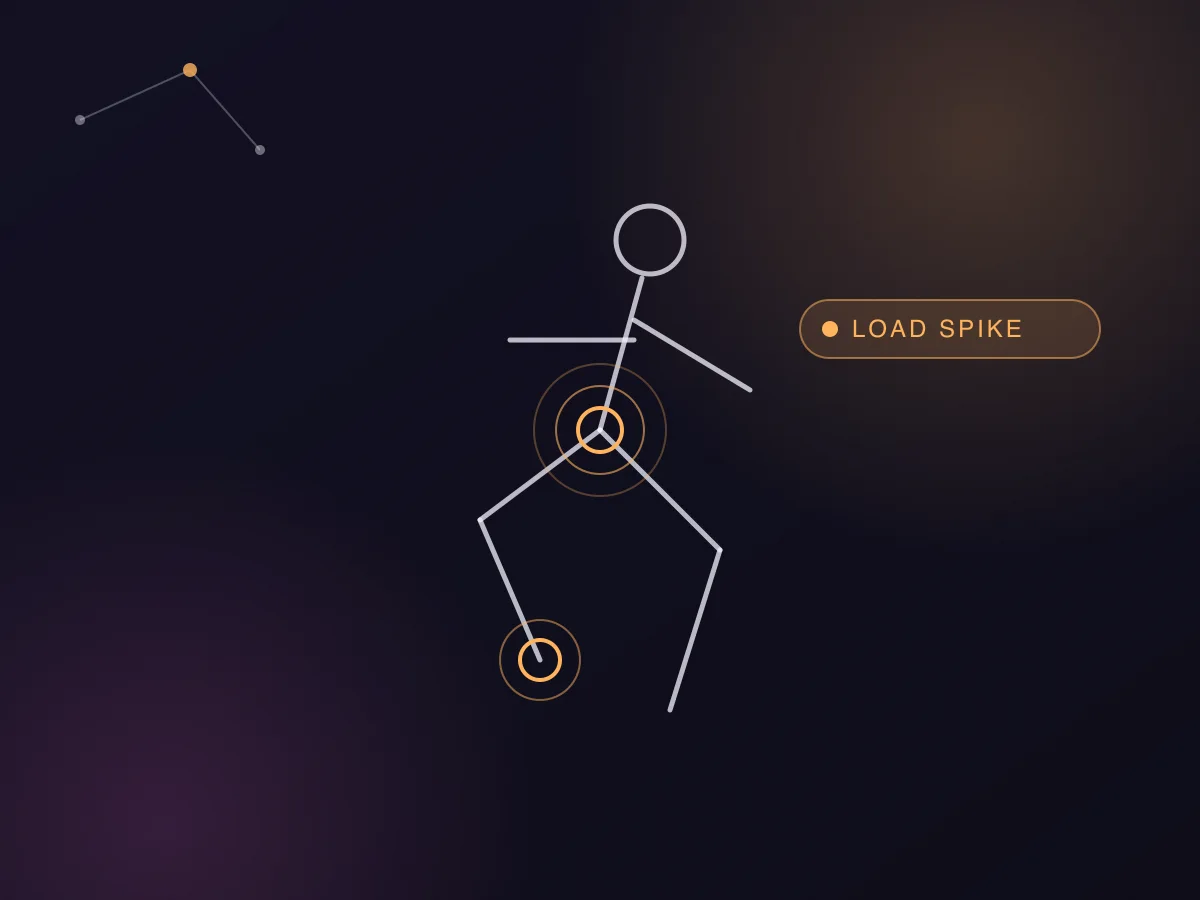
Human movement hides its problems until they become injuries. Knee and hip loading patterns that end seasons are invisible on the field, and physiotherapy exercises done wrong between sessions quietly slow recovery. Two clients, one underlying question: can software see movement the way an expert does, live?
What we built
We answered it twice with two different sensing strategies. For Torq Labs, sensor-laden athletic wear: high-frequency motion capture from garment sensors, fused and filtered on the edge, with models flagging risky knee and hip loading as it happened and research-grade telemetry for sports scientists. For Fisio, no hardware at all: markerless pose estimation from a single commodity camera, movements digitized and scored against reference exercises, with live form feedback so patients self-correct mid-rep and therapists review progress remotely.
What changed
- Knee and hip loading anomalies flagged live from garments in play
- Research-grade sensor data trusted by sports scientists (torqlabs.com)
- Camera-only pose tracking with live form feedback, no wearables needed
- Exercises scored against references; therapists supervise remotely
What production made hard
- Feedback had to land inside the movement. A flag after the play or a correction after the set is worthless, so garment streams were fused and filtered at the edge and the camera pipeline had to keep pace with a rep in progress. Latency budgets, not accuracy alone, shaped the architecture.
- Garment sensors are not lab sensors. Fabric shifts, bodies sweat, and hard athletic movement jolts everything, so high-frequency streams arrived noisy and drifting. Fusion and filtering had to produce data clean enough for sports scientists to treat as research-grade.
- One commodity camera is a flat view of a three-dimensional problem. Markerless pose estimation had to survive ordinary rooms: poor lighting, odd angles, loose clothing, joints occluded mid-exercise, and every body type a clinic actually sees.
- There is no dataset called correct movement. Risk flags and form scores had to be calibrated against expert judgment, and tuned to catch real faults without punishing harmless individual variation. Over-eager corrections erode trust quickly.
- Knowing when to speak was a design problem of its own. Both products kept experts in view rather than fully replacing them: sports scientists reading the garment telemetry, therapists reviewing exercise records remotely.
What a similar project needs
- Recorded movement data with expert labels comes first. Plan capture sessions with real athletes or patients, and with the specialists who can say what good movement looks like. Labeling is the foundation of the project, not a chore to rush.
- A feasibility pass on recorded data before anything live. Prove the signal or the pose track holds up offline, then move to real-time feedback, then harden across bodies, rooms and devices. The hardening tail is real work; budget for it.
- A mixed team, not a pure ML one: signal or vision engineers, mobile or embedded hands for the edge, and domain experts such as physiotherapists or sports scientists in the loop from the start.
- The big risks live outside the lab: device and sensor variety, feedback so frequent that users learn to ignore it, and health-adjacent framing. Present output as guidance, route concerns to professionals, and design for the privacy expectations movement and health data carry.
- Start smaller than the product vision: one movement, one sensing strategy, scored against expert judgment. That is a scoped prototype sprint, and it tells you whether the hardware bet is worth making.
Have a problem in this shape?
Tell us what you are trying to win. We will map your version of this build in one call.