
Consumer health · Computer vision
Skin analysis and advisory
The context
Consumer health, skincare. The client was building a product whose core promise was the assessment itself, not a bolt-on feature: point a phone at your face, get an honest read. The operating environment was the open world: ordinary phone cameras, uncontrolled lighting, every skin tone and age. Constraints were firm: a result in under a minute from one selfie, guidance a lay person can act on, careful handling of anything that looked medical, and no per-user human review at consumer scale.
Why normal software was not enough
No rules engine can read a face. Wrinkles, tone, texture and blemishes are visual, continuous, and different in every photo, so hand-written logic and questionnaire scoring were never options. Only vision models trained and validated on real-world selfies could assess skin from one image, and only a condition-aware advisory layer could turn that assessment into guidance specific to the person, not a generic quiz result.
The problem
Skincare advice was either a dermatologist appointment or a guess at a shop counter. The product goal: point a phone camera at your face and get an honest, personalized read in the time it takes to take a selfie.
What we built
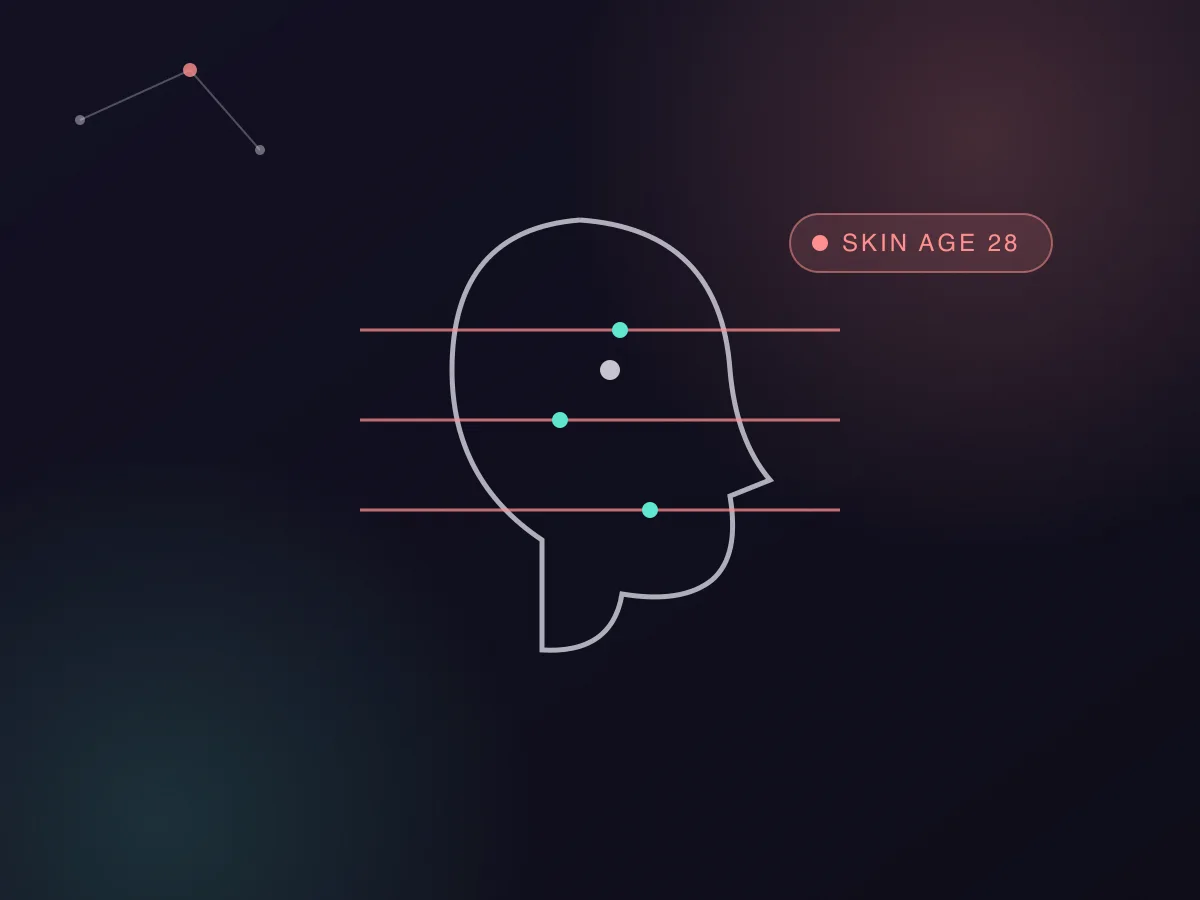
We built vision models that assessed skin condition from a single selfie, wrinkles, tone, texture, blemishes, distilled into a relatable skin age, then paired the assessment with a personalized advisory engine mapping conditions to routines and products. Edge cases and sensitive results were phrased with care and routed toward professional advice.
What changed
- Full skin assessment and skin age from one selfie in under a minute
- Personalized skincare guidance mapped to detected conditions
- Worked across skin tones and lighting conditions in the wild
- Advisory framed to guide toward professionals where appropriate
What production made hard
- Selfies arrive ugly: bad lighting, odd angles, makeup, filters and low-end cameras. The models had to hold up on those images, not on studio captures.
- Consistency across skin tones was a requirement, not an average. Training and validation data had to be deliberately balanced so accuracy did not quietly concentrate on some complexions.
- The line between cosmetic and medical is thin. Sensitive results had to be phrased with care and routed toward professional advice, a product-policy decision as much as a modeling one.
- Repeatability: users retest. Two selfies of the same face in similar conditions had to land on a similar skin age, or trust in the whole product collapses.
- Everything, capture to assessment to personalized advice, had to fit inside the under-a-minute promise on ordinary phones.
What a similar project needs
- Real-world image data spanning skin tones, ages, lighting and cameras, with condition labels checked against domain experts. A clean studio dataset alone will not survive contact with users.
- A timeline shaped like ours: a short prototype sprint proving the core assessment on real images, then a longer hardening phase dominated by in-the-wild image quality, fairness validation and advisory tuning.
- A small mixed team: vision engineers, a product or mobile engineer, and domain expertise to define labels, thresholds and the advisory rules.
- A decision, made early, on what counts as sensitive: which results get softened phrasing and a nudge toward professionals. That boundary needs sign-off from whoever owns legal and brand risk.
- Eyes on the real risks: overclaiming into medical territory, scores that wobble between retakes, and skin-tone bias found after launch instead of before. All three are testable before shipping.
Have a problem in this shape?
Tell us what you are trying to win. We will map your version of this build in one call.